Comparisons
Static vs Dynamic QR Codes
What the redirect actually buys you, measured on real encoded codes, and which payloads are worse off for it.
16 min readA wedding suite is three or four printed pieces, posted months apart. The question is not how to make a code, which takes ten seconds below, but which cards should carry one and what each one should open.
✓ Scan-tested: this code reads back correctly.
Contrast 21:1, Strong
Version 3 · 37 modules · print at least 14.8 mm wide
Each piece of a suite is read at a different moment and posted at a different time, so they do not want the same code. The timing column is the one couples skip, and it is the one that decides whether a code still works when somebody scans it.
| Card | Posted | Point it at |
|---|---|---|
| Save the dateThe riskiest code in the suite, because it has the longest gap between printing and use. If the website is not built yet, this is the one card where a dynamic code genuinely pays for itself. | Six to twelve months before | The wedding website, or a holding page with the date and city |
| The invitationOne job, one code. Resist adding a second code to this card: the invitation is the piece guests read most carefully and the least place to make them choose. | Six to eight weeks before | The RSVP form |
| The details or enclosure cardWhere a code earns the most. All of that information changes, and none of it fits on a card. Point at one page holding all of it rather than printing four codes. | Sent with the invitation | Directions, the hotel block, the schedule, the dress code, the registry |
| The order of service or menuOptional, and the one place a code is genuinely decorative. Guests at the reception are already there, so the code has to offer something the paper cannot. | On the day | A song request form, or the photo album |
The temptation once you have a generator open is to give every piece of information its own code: one for the RSVP, one for directions, one for the hotel block, one for the registry, one for the playlist. The result is a guest holding a card with four black squares on it, deciding which one to scan, and scanning none.
Two is the working number. The RSVP form on the invitation, because that is the one action you actually need from them. Everything else behind a single code on the details card, pointing at one page that holds directions, timings, the hotel block and the registry together. That page can change as often as you like without touching anything printed.
An enclosure card is small and already busy, so the length of the address decides how small the code can be printed and still read. Each row was encoded and decoded when this page was built.
| Link form | Characters | Version | Modules | Print at least |
|---|---|---|---|---|
| A short page on your own wedding domainhttps://janeandalex.com/detailsOne address holding directions, timings and the registry. Shortest code in the suite. | 31 | 3 | 37 | 14.8 mm |
| A wedding platform details pagehttps://www.zola.com/wedding/janeandalex2026/travelTypical of Zola, The Knot and Joy. Every path segment is modules on a small card. | 51 | 4 | 41 | 16.4 mm |
| A pinned map locationhttps://maps.app.goo.gl/aBcDeFgHiJkLmNoPThe Share link from Google Maps, and much shorter than the address bar version. | 40 | 3 | 37 | 14.8 mm |
| A registry pagehttps://www.example-registry.com/registry/janeandalex-2026-weddingRegistry URLs are long, and this is the code most often printed smallest. | 66 | 5 | 45 | 18 mm |
A registry link is usually the longest thing anyone tries to encode on a wedding card, and it is often given the least space. If the registry has to have its own code, give it the room the measurement asks for, or put it behind your own details page instead.
A save the date is posted up to a year before the wedding, and a year is a long time in wedding planning. The website gets renamed, the platform gets switched, the holding page gets replaced by the real one. Whatever address is printed on that card in month one has to still resolve in month twelve, and often it does not.
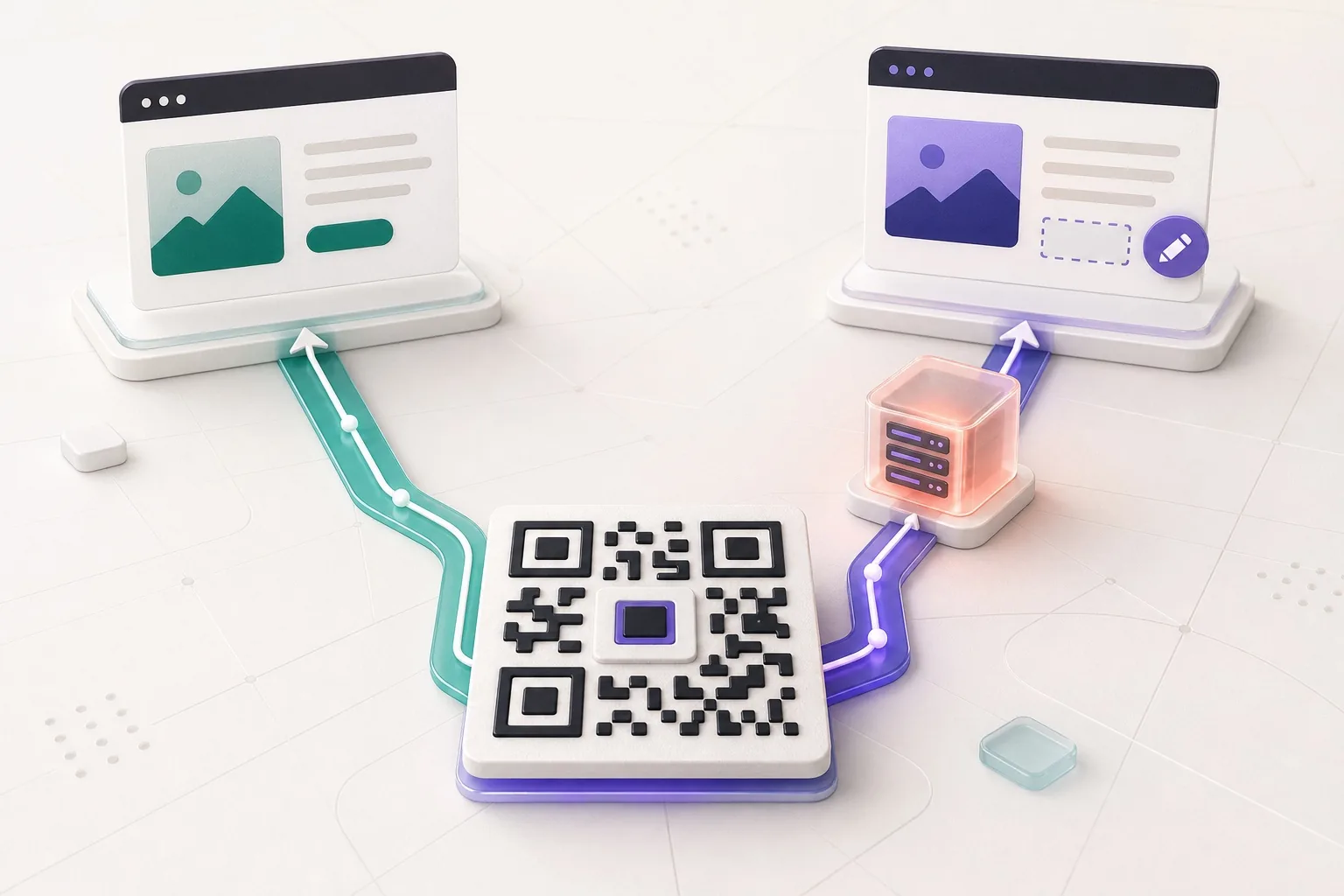
This is the clearest case in the whole suite for a dynamic code: the printed square stays the same and you repoint it when the site exists. For the invitation itself, posted six to eight weeks out against a form that already exists, a static code is simpler and has fewer things that can fail.
If your RSVP form supports pre-filled links, a code per household is a real improvement: the guest scans and sees their own name and the number of seats they were given, rather than typing it and guessing. It also stops the couple who were invited alone from adding four people.
Put the personalised links in a spreadsheet column with the household name beside them, and the bulk generator will produce one file per guest, named after them, with their name printed under the code so your stationer can match card to code without opening every file.
Decide what the code should open first, usually the RSVP form or a details page, then paste that address into the generator on this page and download the SVG. Send the SVG to your stationer rather than a PNG: they will place it into the artwork at whatever size the card allows, and vector art stays sharp at any of them.
No. One code per card at most, and most suites need only two: the RSVP form on the invitation, and a details page on the enclosure card. Printing four codes across a suite makes guests choose which square to scan, which is the fastest way to have none of them scanned.
The wedding website if it exists, or a simple holding page with the date and the city if it does not. A save the date is posted up to a year ahead, so it is the piece most likely to outlive its link. If the site is not built, use a dynamic code and repoint it when it is.
Yes, and it is worth it for RSVPs, because a personalised link can pre-fill the guest's name and the number of seats they were given. Put the links in a spreadsheet column and use the bulk generator, which names each file after the guest and prints their name under the code so the stationer can match them.
Only if it is treated as an afterthought. A code is a black square, so it wants the same care as any other element: give it a clear panel, keep the quiet zone empty, size it deliberately rather than shrinking it to fit a gap, and print the address in text beneath it so the card still works without it.
The SVG. Printers and designers work in vector, so an SVG drops into the artwork and scales cleanly, while a PNG has a fixed resolution and goes soft when enlarged. Download both if you also want something to preview on a screen.
QRMakery builds every code on your own device, free, and the codes never expire.
Invitations, RSVPs, guest photos, and scanning people in at the door.
What the redirect actually buys you, measured on real encoded codes, and which payloads are worse off for it.
16 min readThe usable square inside a round sticker is 70% of its diameter. Measured minimum sizes for real links, against every common sticker size.
8 min readWhat each platform already ships, the measured cost of each payload type, and how to check an offline claim yourself.
26 min read