Comparisons
Static vs Dynamic QR Codes
What the redirect actually buys you, measured on real encoded codes, and which payloads are worse off for it.
16 min readMake your code, press the SVG button, and you have one file that prints sharp at 20mm on a business card and at 1200mm on a banner.
No account, no watermark, no upload. The download unlocks once the code has been rendered and read back correctly.
✓ Scan-tested: this code reads back correctly.
Contrast 21:1, Strong
Version 2 · 33 modules · print at least 13.2 mm wide
A raster file has to carry enough pixels for the biggest thing you will ever print it on, and that requirement grows with the square of the width. A vector file describes the shapes instead of the pixels, so the same bytes serve every size.
| Printed at | Width | PNG needed at 300dpi | This SVG |
|---|---|---|---|
| Business card corner | 20 mm | 236 × 236 px0.1 MP | 3265 bytes |
| Flyer | 40 mm | 472 × 472 px0.2 MP | 3265 bytes |
| Poster | 150 mm | 1772 × 1772 px3.1 MP | 3265 bytes |
| Shop window vinyl | 400 mm | 4724 × 4724 px22.3 MP | 3265 bytes |
| Exhibition banner | 1200 mm | 14173 × 14173 px200.9 MP | 3265 bytes |
This is the reason a printer asks for vector artwork. If you only have a PNG and the job is large, there is no way to recover the detail: enlarging a raster QR code softens exactly the module edges the scanner is trying to measure.
It is plain SVG with no embedded fonts and no external references, so it opens in Illustrator, Inkscape, Figma, Affinity and any browser. The dark modules are one path rather than one rectangle per module: horizontally adjacent modules are merged into runs, so a row of five dark modules is a single rectangle in the path data. For a mid-sized symbol that is roughly a tenth of the bytes, and it is far less work for a print RIP.
Two things are safe to change and one is not. You can recolour the path, and you can scale the whole file. You cannot move, delete or reshape individual modules, and you must not crop the margin: the quiet zone is part of the code, and trimming it to fit a layout is one of the most common reasons a printed code fails.
If you want rounded modules or dots, those add separate elements alongside the path, because a path cannot express a corner radius. The three finder squares stay square in every style. A transparent background simply omits the background rectangle, which is why the SVG is the cleanest way to hand one to a designer.
Keeping the vector file is also what makes a code genuinely long-lived: it is what lets you reprint at any size years later. That argument, and what else can quietly break a printed code, is on the permanent codes page. For the specific case of fitting one onto a CV, the resume page measures the link forms against the space you actually have.
Because a vector file has no resolution to outgrow. The same SVG prints crisply on a business card and on a banner, while a PNG has to carry enough pixels for the largest size you will ever use. For anything going to a printer, send the SVG.
Yes, with no account and no watermark. The download unlocks once the code has been rendered and read back correctly, which is the only gate on this site.
Yes. It is plain SVG with the dark modules as a single path and no embedded fonts, so it opens anywhere. You can recolour the path, but do not move, delete or reshape individual modules, and never crop the quiet zone.
Horizontally adjacent modules are merged into runs, so a row of five dark modules is one rectangle rather than five. That makes the file a fraction of the size and is easier for a printer to process. Rounded and dotted styles add separate elements, because a path cannot express a corner radius.
It scans better in print, because there are no pixels to soften at the module edges. On screen the two are equivalent. The code on this page is decode-tested from the same rendering the file contains, so what you download is what was verified.
Colour, a logo in the middle, artwork behind it, each one measured against what still scans.
What the redirect actually buys you, measured on real encoded codes, and which payloads are worse off for it.
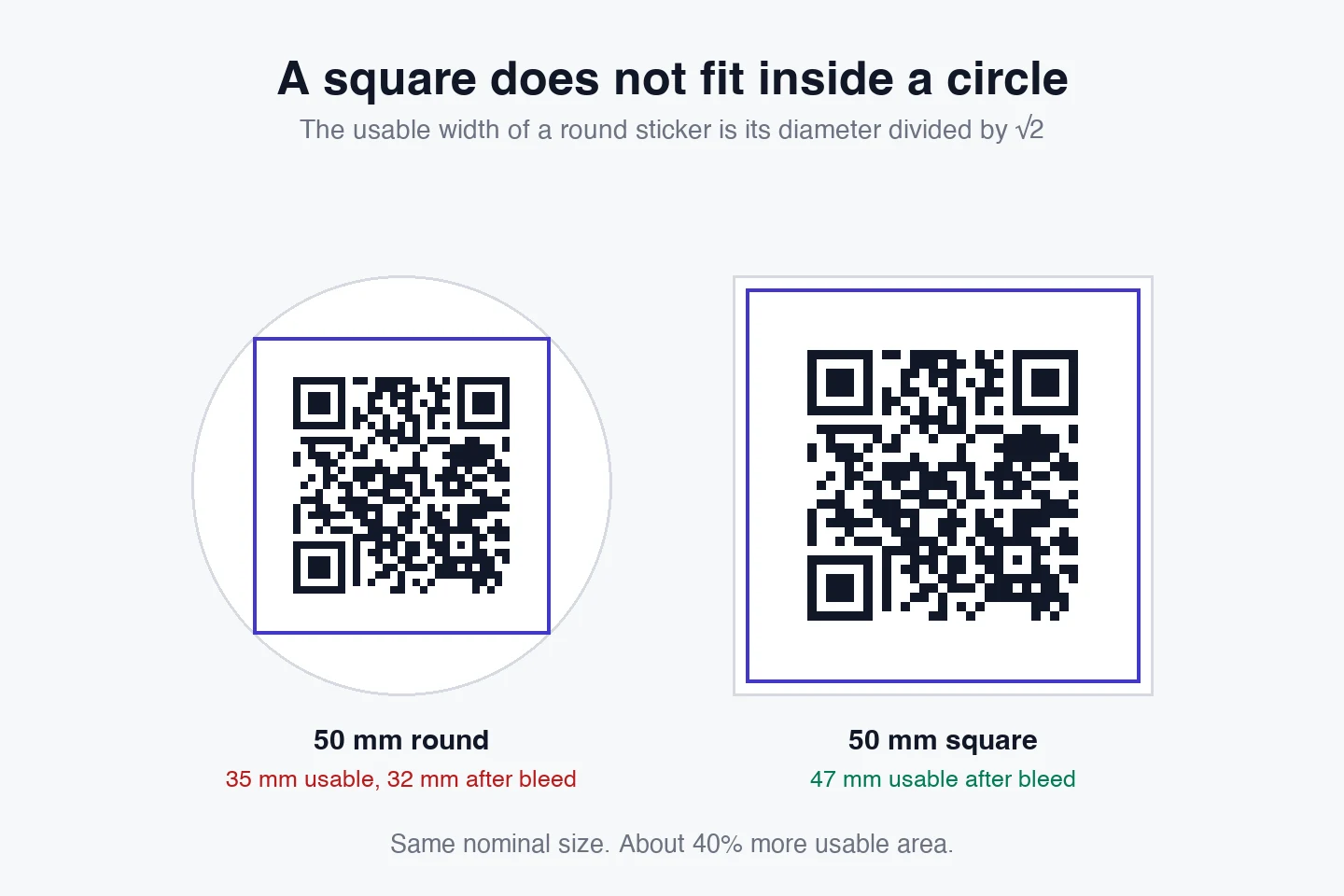
16 min readThe usable square inside a round sticker is 70% of its diameter. Measured minimum sizes for real links, against every common sticker size.
8 min readWhat each platform already ships, the measured cost of each payload type, and how to check an offline claim yourself.
26 min read