Comparisons
Static vs Dynamic QR Codes
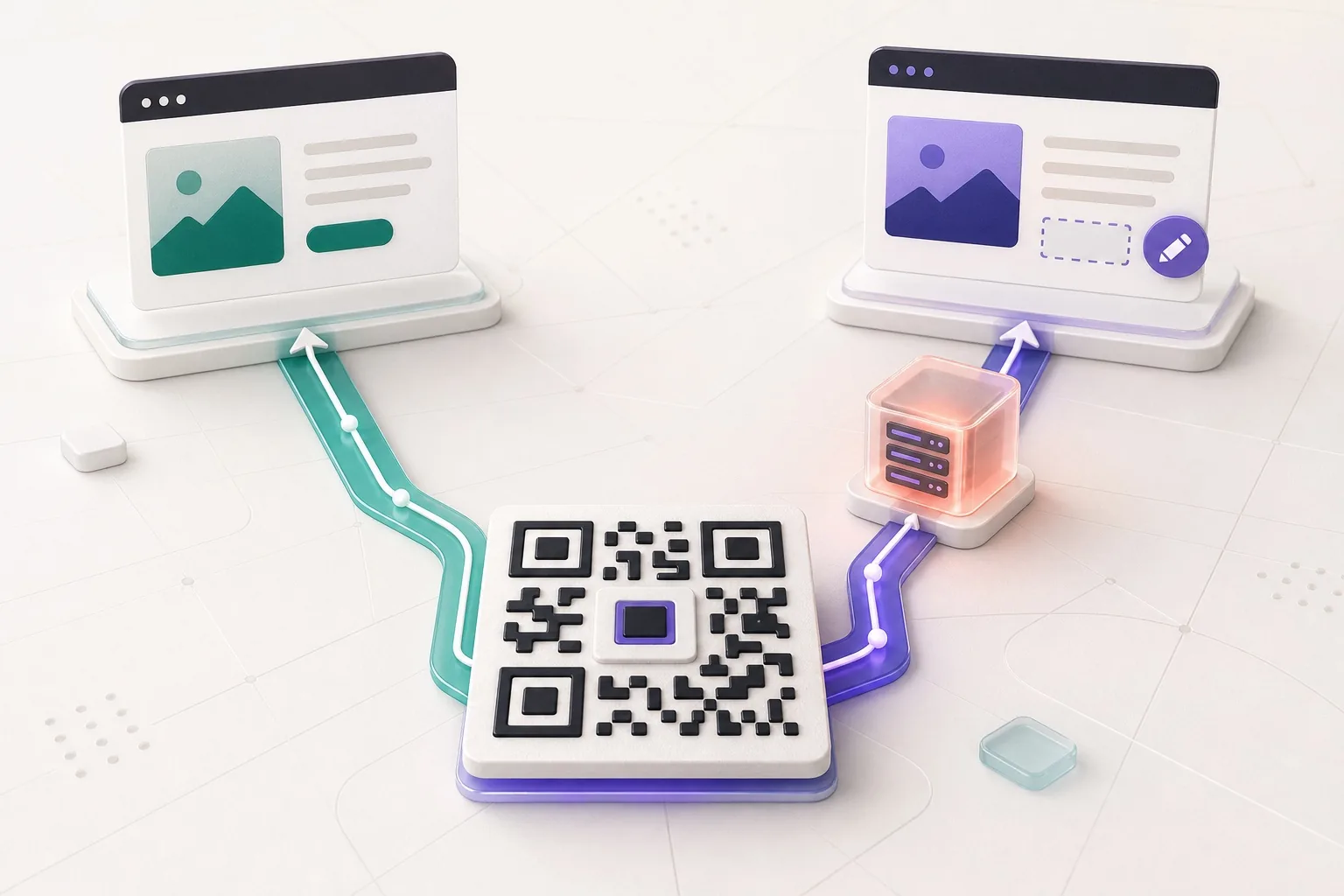
What the redirect actually buys you, measured on real encoded codes, and which payloads are worse off for it.
16 min readCodes for caption cards, wall panels and interpretation boards, with the two things that actually decide whether visitors can use them: how far away they are standing, and whether there is any signal where they are standing.
Free, no account, and the file is a vector you can drop into the label artwork.
✓ Scan-tested: this code reads back correctly.
Contrast 21:1, Strong
Version 2 · 33 modules · print at least 13.2 mm wide
Most gallery codes are designed at a desk, where the label is 150mm from your eyes, and then installed somewhere a visitor stands a metre and a half away behind a case. The code did not change and the distance did, and distance is what a QR code is sensitive to.
| Read from | Distance | Print the code | Module pitch |
|---|---|---|---|
| Caption card, leaning inA label beside a cabinet. The visitor is as close as they can get. | 0.4 m | 40 mm wide | 0.98 mm |
| Behind a rope or a caseThe usual gallery setup. Most codes are sized for the case above. | 1.5 m | 150 mm wide | 3.66 mm |
| Wall panel at the room entranceRead while walking in, often by somebody not stopping. | 3 m | 300 mm wide | 7.32 mm |
| Large-format interpretation boardOutdoor sites, industrial exhibits, anything you cannot approach. | 6 m | 600 mm wide | 14.63 mm |
The practical consequence for a caption card is that if the code has to live at 25mm because that is the space the design allows, then the visitor has to be able to get within about 250mm of it. If a case or a rope stops them, the code is decoration. Move it to the panel, or make the panel code bigger.
Collections live in thick-walled buildings, basements and converted industrial spaces, which is precisely where mobile signal is worst. A code that opens a web page needs a connection at the moment somebody scans it, and the moment is in front of the object rather than in the lobby where you tested it.
Walk the route with a phone on each of the two main networks and check the signal at the labels, not at the doors. If it is bad, the fix is your own Wi-Fi with a joining code beside the first exhibit and at the entrance. That one code rescues every other code in the building.
For outdoor sites and anything read across a barrier, the sign board sizing covers longer distances than the table above, along with glare and weather. And take the SVG into the label artwork rather than a raster file, so the same code can be reset at panel size without softening.
Size it for the distance the visitor actually stands at, not for the label. A code read from behind a rope at 1.5m needs to be several times wider than one on a caption card somebody can lean into. The table on this page does the arithmetic for a real link.
A code pointing at a web page will not. This is the single most common failure in museum use, because thick walls and basements are exactly where collections live. Test the signal at the label, and consider your own Wi-Fi with a joining code beside the first exhibit.
Something that loads fast and reads well on a phone held one-handed. Audio and long-form text both work; a PDF of the exhibition catalogue does not, because it needs pinching and zooming while standing up.
No, but they need contrast, and gallery labels are often light grey on white or white on dark grey. The tool measures the ratio and refuses colours that will not read. Under gallery lighting, which is usually dim and directional, leave more margin than you would for print.
Yes, if it points at a page that offers the choice, which is better than printing four codes on one label. Keep the choice at the top of the page: a visitor standing in front of an object will not scroll to find it.
Menus on tables, sized for the distance somebody reads them from.
What the redirect actually buys you, measured on real encoded codes, and which payloads are worse off for it.
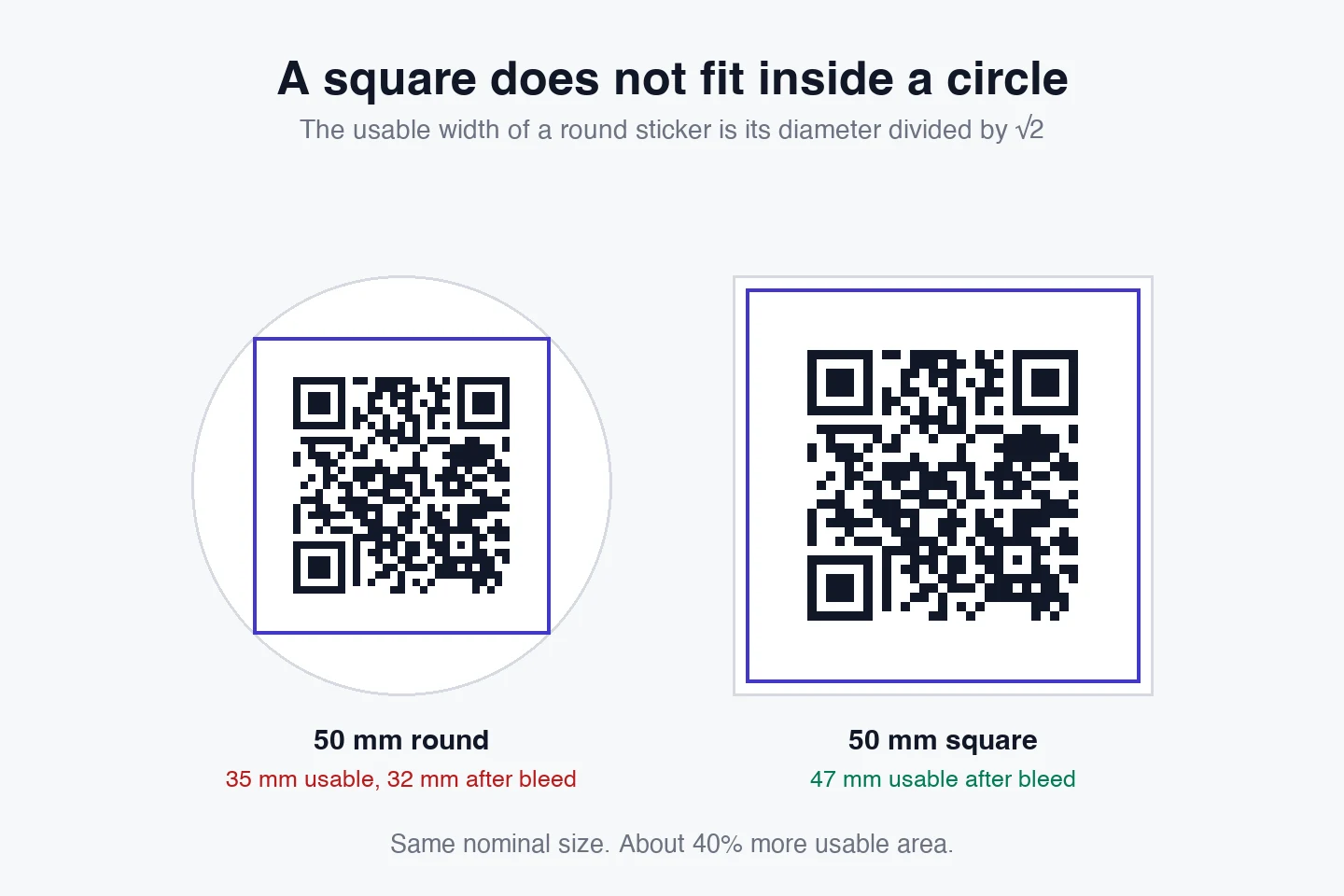
16 min readThe usable square inside a round sticker is 70% of its diameter. Measured minimum sizes for real links, against every common sticker size.
8 min readWhat each platform already ships, the measured cost of each payload type, and how to check an offline claim yourself.
26 min read