Comparisons
Static vs Dynamic QR Codes
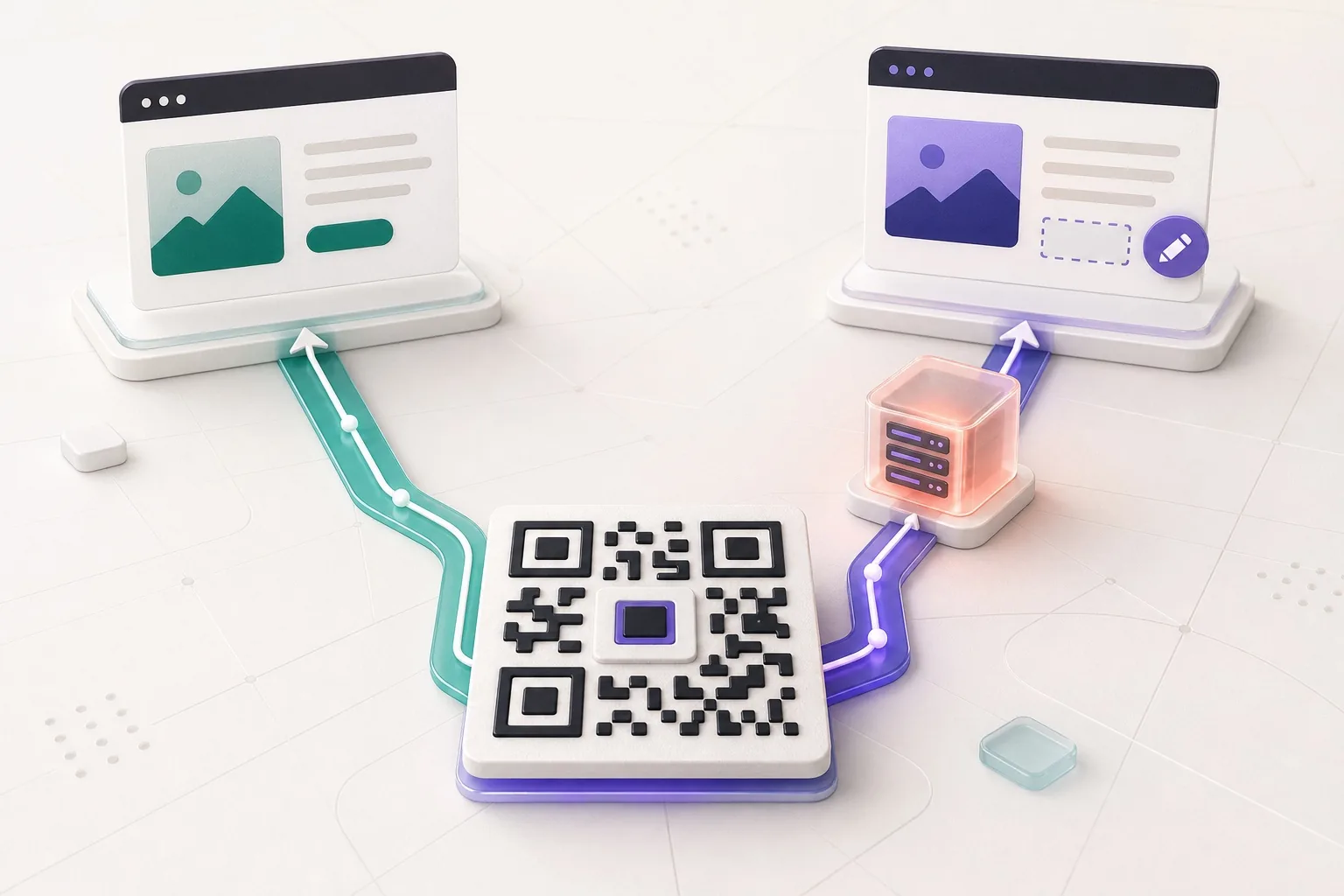
What the redirect actually buys you, measured on real encoded codes, and which payloads are worse off for it.
16 min readPaste your guest list and every guest gets their own code for their invitation. On the day, scan them at the door: the screen shows the name, the seats and the table, and it tells you when the same invitation arrives twice. No account, no server, and no signal required.
Nothing to read yet. A spreadsheet paste keeps its columns.
Every other check-in product is a hosted service with an account, per-event pricing and your guest list on their servers. That buys real things: two doors sharing one list, a dashboard from the office, support at eleven at night. It also assumes the venue has working wifi at the exact moment a hundred people arrive together, and wedding venues are frequently converted barns with one bar of signal.
This runs entirely in the browser on the device at the door. The list, the codes and the arrivals never leave it, so the door works in a basement, and a list of your guests’ names is never somebody else’s data to lose. The cost is stated plainly in the next section rather than discovered at the door.
Two codes usually go out before the door opens. An event code on the invitation puts the date and venue in a guest's calendar, and a map code gets them to it. Neither needs an account, and both work on the same printed card as the check-in code.
Weddings, where the code goes on the invitation and the door person is an usher with a phone. Staff parties and awards nights, where the list is an export from HR. Class registers and training sessions, where the same printed card is scanned every week and the export is the attendance record. Private views and members’ events, where the only question at the door is whether this person was invited.
If the codes are going onto wedding stationery, the invitation page covers which card should carry them, and the bulk generator is the same pipeline this uses to build the sheet.
Every guest gets their own code, printed on their invitation or ticket. At the door you scan it with a phone or tablet, and the screen shows who they are, how many seats they were given and any note you added, such as a table number. The scan is recorded, so a second scan of the same code says so.
Yes, and that is the main reason it is built this way. The guest list, the codes and the arrivals all live in the browser on the device at the door, so nothing is looked up while a queue is forming. Venue wifi is exactly what stops working at the moment two hundred people arrive at once.
They can try, and the screen will say so. The second scan shows the guest as already checked in and the time of the first scan, which is the case a printed list handles worst and the main reason to scan at all.
In your browser, on the device you set it up on. It is never uploaded, because a guest list is a list of real people's names and none of it needs to be on somebody else's server for you to print some squares. Clearing your browser data removes it, so export the arrivals when the event ends.
Not with one shared list. Each device keeps its own copy, so two doors means two lists that will not know about each other. Split the guest list by surname if you need two doors, which is how a paper list is run anyway, or use one device at one entrance.
Up to 1000 on one list. Above that the door queue is a bigger problem than the software, and you want two entrances and two lists.
No. There is no payment, no seat allocation, no refunds and no fraud protection. The code carries a guest number and a check block that stops last year's invitation opening this year's door, which is right for a wedding, a staff party or a class register, and not enough for a paid event where a forged ticket is worth money.
QRMakery keeps this entirely on your device. The guest list, the codes and the arrivals never reach a server, and the door works with the network off.
Invitations, RSVPs, guest photos, and scanning people in at the door.
What the redirect actually buys you, measured on real encoded codes, and which payloads are worse off for it.
16 min readThe usable square inside a round sticker is 70% of its diameter. Measured minimum sizes for real links, against every common sticker size.
8 min readWhat each platform already ships, the measured cost of each payload type, and how to check an offline claim yourself.
26 min read