On this page6 sections
The Economics Decide It Before Anything Else
Most comparisons of these two work through the technology first. In practice the decision is made on two numbers, and the technology follows.
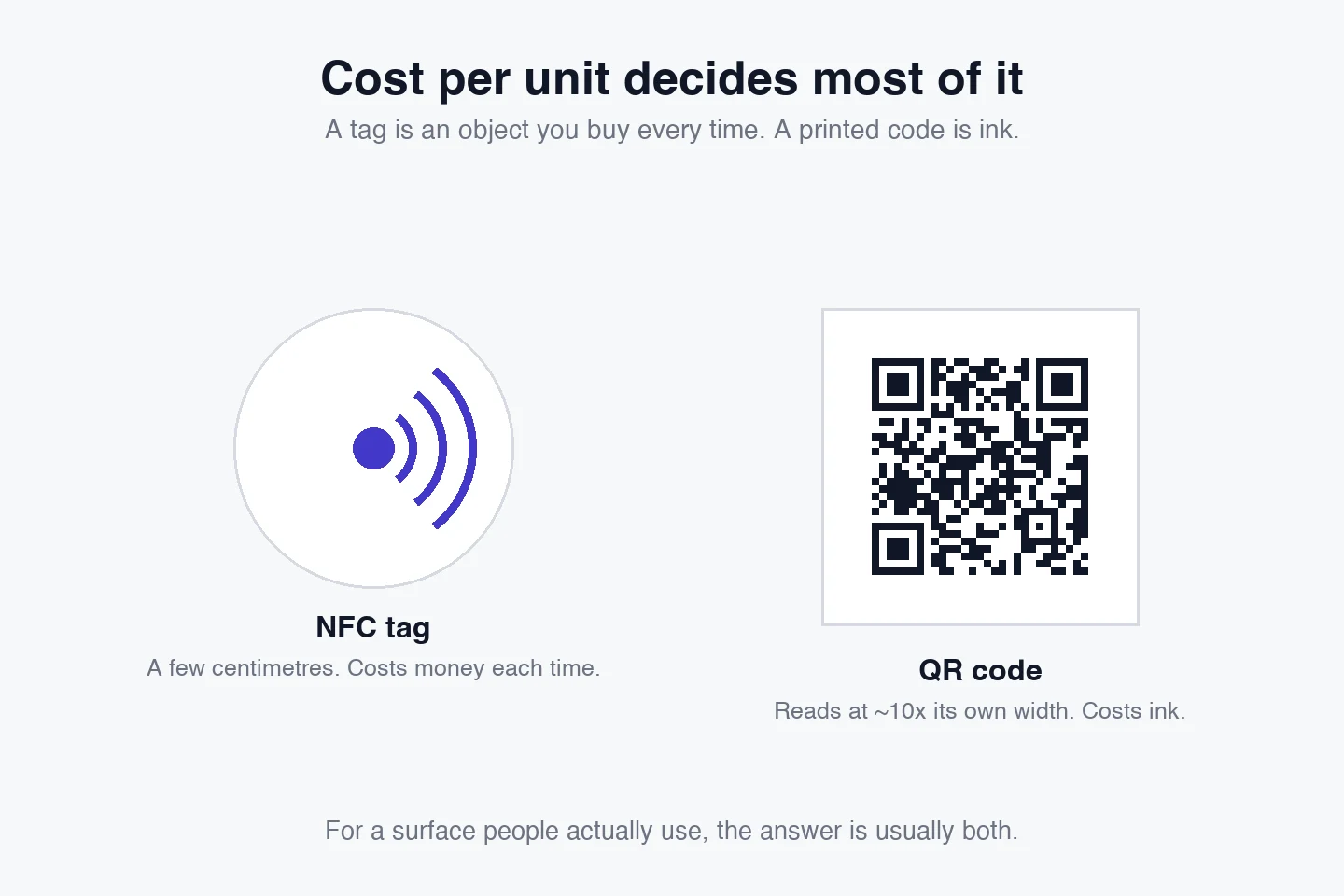
The first is cost per unit. An NFC tag is a physical object that has to be bought, programmed and applied, one at a time, and that cost repeats for every place you want the interaction. A QR code is a mark on something you were already printing, so the second one is free and so is the thousandth. The moment the deployment is a print run rather than a handful of touchpoints, the argument is over.
The second is range. NFC is a few centimetres by design, which is a feature for a payment terminal and disqualifying for a poster. A QR code reads at roughly ten times the width of the symbol, so a large printed one works from across a room or a road. If the person cannot reach the surface, NFC is not a candidate at all.
Side by Side
| Attribute | NFC tag | QR code |
|---|---|---|
| Cost per unit | A tag costs money, every single time, and has to be applied. | Ink. A thousand codes cost the same as one. |
| What the person does | Holds a phone within a few centimetres. No app, no aiming. | Points a camera and taps a notification. Works from across a room. |
| Range | A few centimetres, by design. It cannot be read from a distance. | Roughly ten times the width of the symbol, so a large one reads from metres away. |
| Phone support | Most modern phones read tags in the background, though it can be switched off and some budget handsets omit the hardware. | Any phone camera since roughly 2017, with nothing to enable. |
| Works through | Fabric, a thin case, a shop window, and darkness. | Nothing. It needs line of sight and usable light. |
| Survives | Dirt and being scuffed, since nothing has to be seen. | Being photocopied, screenshotted, faxed and reprinted forever. |
| Changing the destination | Rewritable tags can be reprogrammed, one tag at a time, in person. | Only by reprinting, unless it points at a redirect you control. |
The row worth pausing on is the last but one. A QR code survives being photographed, screenshotted, photocopied and printed again, which is a property no tag has. That is a real advantage for anything meant to spread, and a real risk for anything meant to be unique.
Where NFC Genuinely Wins
There are cases where a tag is straightforwardly the better answer, and it is worth being clear about them rather than defending the printed code out of habit.
- Repeated daily use. Tapping is faster than scanning once somebody has done it twice, and the difference compounds for staff.
- Bad light or no light. A camera needs to see. A tag does not, which matters in a dim bar or a dark stairwell.
- Nothing visible to design around. A tag can sit under a laminate, inside a product or behind a poster, leaving the surface clean.
- Changing the destination. A rewritable tag can be reprogrammed in place. A printed static code cannot, unless it points at a redirect you control.
Why the Answer Is Often Both
For a physical touchpoint that people will actually use, the honest recommendation is usually both, pointing at the same address.
A tag handles the people who tap and the printed code handles everyone else: the phone with NFC switched off, the budget handset without the hardware, the thick case, and the person who simply does not know tapping is an option. The printed code is also what tells anybody the interaction exists at all, because a tag is invisible.
And the printed code is the fallback when the tag fails, which eventually it does. That asymmetry is the reason not to ship a tag-only touchpoint: a broken tag with no printed code beside it is a dead surface with nothing to tell the customer what went wrong.
What Is Claimed and What Is Sourced
The QR side of this page is consistent with this site's own measurements and with ISO/IEC 18004. The NFC side is drawn from the published specifications and from documented platform behaviour, and nothing about NFC was tested here, because this site has no NFC hardware in it.
Two figures deserve their caveats. Cost per tag moves constantly with volume and tag type, so no price is quoted. And the ten-times range rule for QR is a trade rule of thumb rather than a specification, which the sign board sizing page works through in more detail.
The other two comparisons in this set are QR code vs barcode and Data Matrix vs QR code.
Common questions
Is NFC better than a QR code?
For a small number of fixed points that people touch, often yes: no aiming, no light, no camera. For anything printed at volume or read at a distance, no. A tag costs money every time and a printed code does not.
Do all phones read NFC tags?
Most modern ones do, and it is less universal than a camera. Background tag reading can be switched off, some budget handsets have no NFC hardware, and a thick case can stop it. Every phone with a camera reads a QR code.
Can you use NFC and a QR code together?
Yes, and on a tabletop or a poster it is the sensible answer: the tag for people who tap and the printed code for people who do not, both pointing at the same address. The printed code is also the fallback when the tag fails.
Which is more secure, NFC or a QR code?
Neither is secure. Both hand a phone a destination the person cannot read first, and both can be swapped by anyone with physical access. A tag can be overwritten in place, and a printed code can be covered with a sticker.
Does NFC work without a signal?
The tap does, and whatever it opens usually does not. That is the same as a QR code pointing at a web page. If working offline matters, encode the content itself, such as a contact card or a Wi-Fi passphrase.
Printing the QR Half?
Contrast measured as you choose colours, the quiet zone preserved, and the download locked until the finished code has been read back.
Open the generatorKeep reading
All guides- Comparisons
Static vs Dynamic QR Codes
What the redirect actually buys you, measured on real encoded codes, and which payloads are worse off for it.
16 min read - Printing
QR Code Sticker Size: The Circle Costs You 30%
The usable square inside a round sticker is 70% of its diameter. Measured minimum sizes for real links, against every common sticker size.
8 min read - Reference
Offline QR Code Generators for Every Device
What each platform already ships, the measured cost of each payload type, and how to check an offline claim yourself.
26 min read