Comparisons
Static vs Dynamic QR Codes
What the redirect actually buys you, measured on real encoded codes, and which payloads are worse off for it.
16 min readIf you are here because something you printed has stopped working, start with the checker below. It tells you what you actually have, which decides what you can do about it.
Scan your printed code with any phone camera and copy the link it shows, before you open it.
The answer appears here. Nothing is sent anywhere.
This reads the link only. It makes no request, so it cannot follow a redirect to see where it finally lands, and a redirect running on a provider's custom domain will read as direct. If you are unsure, check who controls the domain in the link.
The code did not expire. A printed symbol is ink, and it decodes to the same string it always did. What changed is what that string points at.
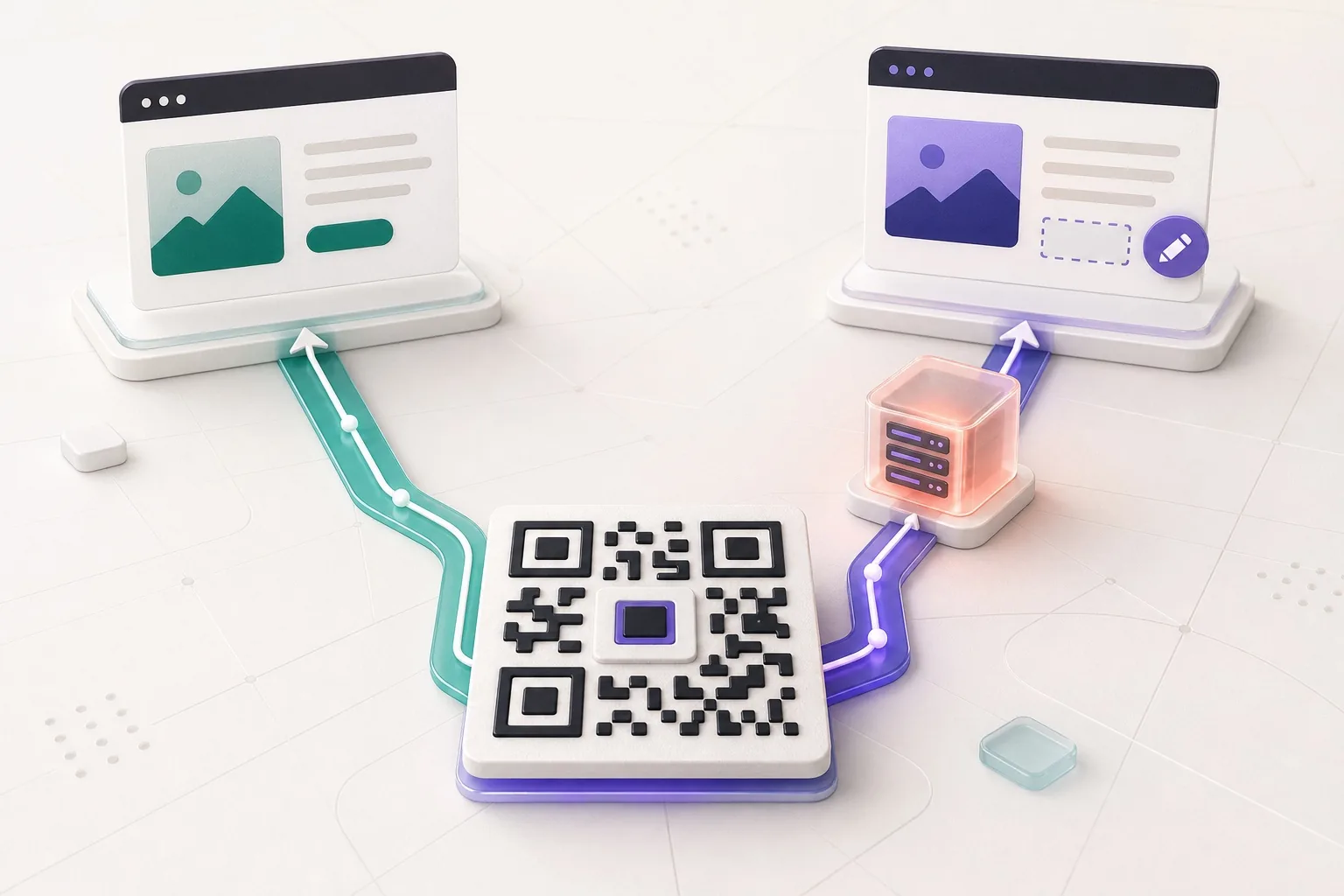
Free generators very often hand out dynamic codes. A dynamic code does not contain your destination at all: it contains a short address on the generator's server, which redirects onwards. That redirect is the product, the free tier is the trial, and when the trial ends the redirect stops. Every copy you printed dies at the same moment, and nothing about the printed code looks any different.
It is worth being fair about this. A redirect is genuinely useful: it is the only way to change a destination after printing, and the only way scan counts are possible. The problem is not that it exists, it is that it is often the silent default when somebody just wanted a code.
This generator makes static codes and nothing else. There is no account to open, no trial to run out, and no server between the phone and the answer, because the encoding happens in this tab. Delete this site tomorrow and every code made here keeps working.
✓ Scan-tested: this code reads back correctly.
Contrast 21:1, Strong
Version 2 · 33 modules · print at least 13.2 mm wide
It is the same encoder as the main generator, with the objection answered up front rather than in a footnote.
Take the SVG and keep it. It is the file that lets you reprint at any size in ten years without going back to any website, including this one.
Our dynamic codes redirect through this site, so they carry exactly the dependency this page is about. If this site goes away, they stop. We are not going to pretend otherwise on a page criticising that model.
The difference is that it is a choice rather than a default, and that the static tool above is the thing this site actually leads with. For the full account of what expires and who controls each part, see permanent QR codes. For why there is no account here at all, see no sign up.
Almost always because it was dynamic. Many free generators hand you a code pointing at their own redirect, then stop redirecting when a trial ends. Every printed copy dies at the same moment. Scan your code and look at the link: if the domain belongs to a QR company, that is what happened.
A static one cannot. It contains the destination itself, so there is no server involved and nothing to switch off. A free dynamic one usually does, because the free part is the trial and the redirect is the product.
Scan it and read the link before opening it. A static code shows your real destination. A dynamic one shows a short address on somebody else's domain. The checker on this page tells you which you are looking at.
Not the printed code. The symbol encodes the redirect address, and that cannot be edited without reprinting. What you can do is make the next print run static, pointing at a web address you own.
No, and there is nothing to count. Scanning a static code involves no server at all: the phone reads the symbol and acts on what is inside. Scan limits only exist where a redirect is being metered.
A link or some text into a code, with nothing else in the way.
What the redirect actually buys you, measured on real encoded codes, and which payloads are worse off for it.
16 min readThe usable square inside a round sticker is 70% of its diameter. Measured minimum sizes for real links, against every common sticker size.
8 min readWhat each platform already ships, the measured cost of each payload type, and how to check an offline claim yourself.
26 min read