Comparisons
Static vs Dynamic QR Codes
What the redirect actually buys you, measured on real encoded codes, and which payloads are worse off for it.
16 min readNo account, no email address, no card. Type what you want encoded and download the file.
Every generator says this, so further down the page there is an audit that measures what this tool actually sends while it works, rather than asking you to believe it.
✓ Scan-tested: this code reads back correctly.
Contrast 21:1, Strong
Version 2 · 33 modules · print at least 13.2 mm wide
It is not arbitrary. Their codes point at their servers, which is what a dynamic code is, and a redirect has to be owned by somebody: managed, billed, and switched off when the bill stops. The account is that ownership record.
A static code has no server in it. The destination is inside the symbol, the encoding is arithmetic that runs fine on your own device, and there is nothing left for an account to hold. That is the whole reason this page can exist, and it is also why the account question and the expiry question have the same answer underneath.
Below is a live audit. It watches this page's own network requests while a code is encoded, using the browser's performance timeline, and reports what it saw. If your data were being sent somewhere to be turned into an image, it would show up here.
Your browser currently reports it is online. Turn your Wi-Fi off and press the button again. The result should be identical, because nothing here consults a server.
The audit watches the browser’s own resource timeline through a PerformanceObserverand reports every request that started while your code was being encoded, this site’s included. It cannot see requests your extensions make, so the conclusive version of this test is your browser’s network panel, or simply pulling the plug.
For the full version of this, including what happens with the network switched off entirely, the offline generator is the page built around it.
Three real things, and it would be dishonest to pretend otherwise. None of them is a restriction on the generator itself, which is the same tool with the same output.
If the first two matter to you, you want a dynamic code, and that genuinely does need an account somewhere, including here. The honest recommendation is to know which of the two you are choosing rather than to be defaulted into one.
Yes. Nothing on this site asks for an account, an email address or a card. The generator runs in your browser, so there is nothing to log in to and no file waiting on a server for you to claim.
Because their codes point at their servers. A dynamic code needs an account so the redirect can be managed and billed, and the account is also how a free trial becomes a subscription. A static code needs none of that.
It stays in the browser tab. The encoding, the contrast check and the decode test all run on your device, which is why the tool works with the network off. The offline page measures its own network requests while encoding, so you can verify this rather than take our word for it.
No watermark, no scan limit, no expiry, and the SVG and PNG downloads are the full files. The only gate is the decode test: the download unlocks once the finished image has been read back correctly.
Three real things: scan counts, the ability to change a destination after printing, and any saved history of what you made. If you need the first two, you need a dynamic code, and that does require an account somewhere.
A link or some text into a code, with nothing else in the way.
What the redirect actually buys you, measured on real encoded codes, and which payloads are worse off for it.
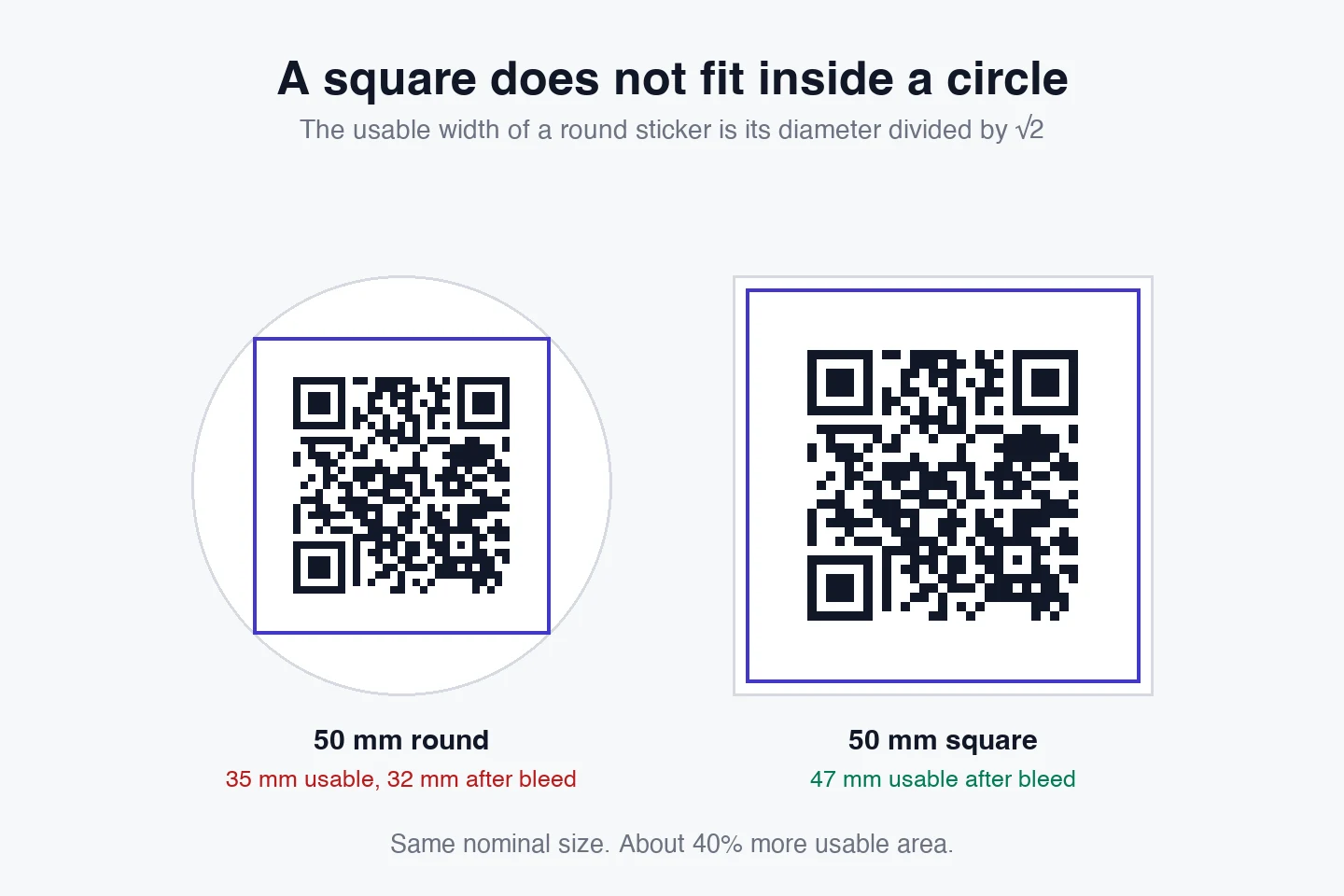
16 min readThe usable square inside a round sticker is 70% of its diameter. Measured minimum sizes for real links, against every common sticker size.
8 min readWhat each platform already ships, the measured cost of each payload type, and how to check an offline claim yourself.
26 min read